
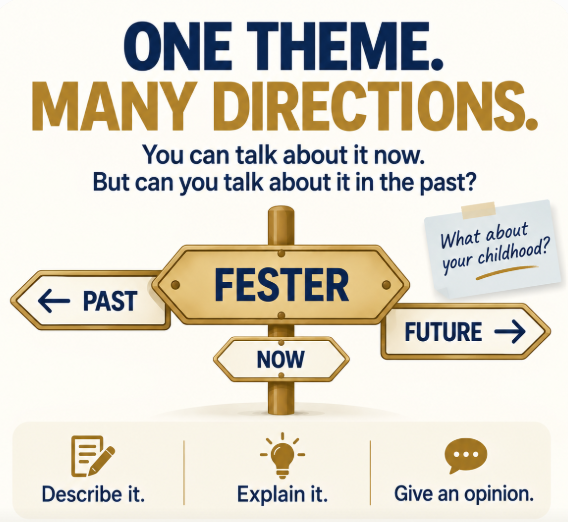
One Sproochentest Theme. Many Different Questions.
You can prepare the theme. But are you ready when the questions change direction? See how official Sproochentest examples move through the past, present, childhood, future, opinions, descriptions and explanations—and how to test your preparation before the interview.
Knowing the topic isn’t the same as being ready for the interview.
You can talk about sleep.
You can say when you normally go to bed. You can say how many hours you sleep. You can explain what you do when you can’t fall asleep.
But can you talk about how you slept as a child?
What helped you fall asleep?
Did your parents control your bedtime?
Did you ever stay overnight with family or friends?
Those questions are all part of the official Sproochentest example for Schlof an Entspanung.
Same theme. Different direction.
And that difference matters.
A Theme Can Move
Preparing vocabulary for a theme is useful. But the interview can take that theme in several directions.
Look at Fester.
You might be comfortable talking about the celebrations you enjoy.
But can you talk about the last celebration you attended?
When was it?
Who was there?
Did you bring a gift?
What were you wearing?
Later in the same official example, the questions move again. You may need to describe a typical wedding, explain what guests shouldn’t do, discuss advantages and disadvantages of a place to celebrate a birthday, and talk about a celebration you’re planning next.
That’s all still Fester.
Test Your Preparation Differently
Pick one of the themes you think you’re ready for.
Now test it.
Can you talk about it now?
Can you talk about it in the past?
Can you talk about it when you were a child?
Can you talk about what you might do in the future?
Then change direction again.
Can you describe something?
Can you explain why?
Can you give an opinion?
If one of those changes makes the theme suddenly much harder, you’ve found something useful to practice.
That’s better to discover while you’re preparing than during the interview.
Don’t Just Prepare the Theme. Prepare for Where It Can Go.
You don’t need to predict every question.
You don’t need to memorize an answer for every possibility.
You do need enough usable Luxembourgish—and enough practice responding to different kinds of questions—to handle a familiar theme when the direction changes.
Before you mark a theme ready, ask yourself:
Am I ready for the theme—or am I ready only for the questions I’ve practiced?
There is a difference.
Practice for the Questions You Haven’t Practiced Yet
If your preparation is built around memorized answers, the interview gets harder as soon as the question moves somewhere you didn’t expect.
That’s exactly why I created the GPS Method.
The GPS resources are designed to help you prepare for the structure of the Sproochentest oral interview—not just collect vocabulary or memorize answers to individual questions.
The GPS Method Guide teaches you a repeatable approach for understanding and responding to unfamiliar questions.
The GPS Method Workbook gives you structured practice applying that approach out loud.
The GPS Interview Series takes you through complete written interview simulations, with primary questions and follow-ups that move through different directions within a theme.
The GPS Question Decoder helps you recognize what a Luxembourgish interview question is actually asking before you try to answer it.
You don’t need another list of answers to memorize.
You need to know what to do when the question you practiced isn’t the question you get.
Before you call a theme ready, test it.
Past. Present. Childhood. Future.
Describe. Explain. Give an opinion.
If you find a direction you can’t comfortably handle, that’s where your practice should go next.
Explore the GPS Luxembourgish preparation resources and build practice around the interview you actually need to navigate.
Learn to navigate the interview—not memorize it.