

One Sproochentest Theme. Many Different Questions.
You can prepare the theme. But are you ready when the questions change direction? See how official Sproochentest examples move through the past, present, childhood, future, opinions, descriptions and explanations—and how to test your preparation before the interview.
Knowing the topic isn’t the same as being ready for the interview.
You can talk about sleep.
You can say when you normally go to bed. You can say how many hours you sleep. You can explain what you do when you can’t fall asleep.
But can you talk about how you slept as a child?
What helped you fall asleep?
Did your parents control your bedtime?
Did you ever stay overnight with family or friends?
Those questions are all part of the official Sproochentest example for Schlof an Entspanung.
Same theme. Different direction.
And that difference matters.
A Theme Can Move
Preparing vocabulary for a theme is useful. But the interview can take that theme in several directions.
Look at Fester.
You might be comfortable talking about the celebrations you enjoy.
But can you talk about the last celebration you attended?
When was it?
Who was there?
Did you bring a gift?
What were you wearing?
Later in the same official example, the questions move again. You may need to describe a typical wedding, explain what guests shouldn’t do, discuss advantages and disadvantages of a place to celebrate a birthday, and talk about a celebration you’re planning next.
That’s all still Fester.
Test Your Preparation Differently
Pick one of the themes you think you’re ready for.
Now test it.
Can you talk about it now?
Can you talk about it in the past?
Can you talk about it when you were a child?
Can you talk about what you might do in the future?
Then change direction again.
Can you describe something?
Can you explain why?
Can you give an opinion?
If one of those changes makes the theme suddenly much harder, you’ve found something useful to practice.
That’s better to discover while you’re preparing than during the interview.
Don’t Just Prepare the Theme. Prepare for Where It Can Go.
You don’t need to predict every question.
You don’t need to memorize an answer for every possibility.
You do need enough usable Luxembourgish—and enough practice responding to different kinds of questions—to handle a familiar theme when the direction changes.
Before you mark a theme ready, ask yourself:
Am I ready for the theme—or am I ready only for the questions I’ve practiced?
There is a difference.
Practice for the Questions You Haven’t Practiced Yet
If your preparation is built around memorized answers, the interview gets harder as soon as the question moves somewhere you didn’t expect.
That’s exactly why I created the GPS Method.
The GPS resources are designed to help you prepare for the structure of the Sproochentest oral interview—not just collect vocabulary or memorize answers to individual questions.
The GPS Method Guide teaches you a repeatable approach for understanding and responding to unfamiliar questions.
The GPS Method Workbook gives you structured practice applying that approach out loud.
The GPS Interview Series takes you through complete written interview simulations, with primary questions and follow-ups that move through different directions within a theme.
The GPS Question Decoder helps you recognize what a Luxembourgish interview question is actually asking before you try to answer it.
You don’t need another list of answers to memorize.
You need to know what to do when the question you practiced isn’t the question you get.
Before you call a theme ready, test it.
Past. Present. Childhood. Future.
Describe. Explain. Give an opinion.
If you find a direction you can’t comfortably handle, that’s where your practice should go next.
Explore the GPS Luxembourgish preparation resources and build practice around the interview you actually need to navigate.
Learn to navigate the interview—not memorize it.
What Actually Happens on Sproochentest Day? A Step-by-Step Walkthrough
Wondering what actually happens on Sproochentest day? Follow my July 2026 experience at INLL Glacis step by step—from check-in and the listening test to choosing an interview theme, answering questions and describing a picture.
You’ve practiced your Luxembourgish. You’ve worked through interview questions. You’ve described pictures.
But there’s another question that can create a surprising amount of anxiety:
What actually happens when you show up for the Sproochentest?
Where do you go? What can you take inside? What does the listening test look like? How do you choose your interview theme and picture?
I took the Sproochentest at INLL Glacis in July 2026, and this is what the process looked like for me—from walking through the doors to collecting my belongings afterward.
A Note About This Walkthrough
The official test format described here is based on current information published by the Institut national des langues Luxembourg (INLL).
The logistical details—where I waited, the lockers, the testing rooms, how my choices were presented and what happened during my assessment—are from my personal experience at INLL Glacis in July 2026.
Procedures can change and individual sessions may vary.
Taking the Sproochentest Soon?
Sproochentest season is starting again. Use code TESTDAY for 15% off GPS Luxembourgish digital practice materials through September 20, 2026.
Keep reading for my step-by-step walkthrough of what test day looked like.
The Basic Sproochentest Structure
The Sproochentest has two compulsory components.
Speaking — A2 level
The speaking assessment lasts approximately 10 minutes:
about 5 minutes for an interview on one of two themes
about 5 minutes describing one of three pictures
Listening comprehension — B1 level
The listening assessment lasts approximately 35 minutes and is completed on a tablet.
INLL describes three types of listening texts: a radio message, a conversation about an everyday topic, and an exchange or presentation on a defined topic.
Both assessments take place during the same half-day session.
Arriving at INLL Glacis
I arrived about 30 minutes early.
At Glacis, the signage was easy to follow. I entered through the double doors, followed a sign directing Sproochentest candidates to the left, continued down the hallway and reached the locker area.
A staff member was there directing candidates to put their belongings into lockers.
During my session, I could keep:
my passport
a bottle of water
tissues
No watch.
My phone, bag and other belongings went into the locker.
Check the instructions for your own session, since procedures can change.
Checking In—and Waiting
After putting my belongings away, I entered the check-in area.
There was a desk on the left and chairs on the right. Staff found my name on the candidate list, and I signed in.
It was busy. Every chair was occupied, with additional candidates waiting around the seating area.
And this is worth knowing:
There can be a lot of waiting.
The published test times don't necessarily tell you how long you'll actually be at INLL.
My Listening Test Came First
Staff called us by name and took us into the listening room.
The room had wooden divided workstations, almost like individual cubicles. Headphones were already at the desks.
We received paperwork, our identification was checked, and tablets were distributed. We logged in, and staff gave instructions in Luxembourgish.
One thing I remember very clearly:
I did not control the pace.
I couldn't pause the assessment, replay something whenever I wanted, or decide when to advance. The test progressed automatically.
I remember hearing each recording twice, which is also consistent with INLL's published sample listening instructions.
I don't remember confidently enough whether I saw the questions before each recording to describe that part from memory. For the exact listening sequence, I recommend using INLL's current sample materials rather than relying on anyone's recollection—including mine.
When the assessment ended, we waited until everyone had finished. Staff collected the tablets and paperwork, and we returned to the waiting area.
Then I waited to be called again.
Then Came the Speaking Assessment
When my name was called, staff checked that I had my passport and specifically verified that I wasn't wearing a watch.
An examiner walked me down the hallway to the testing room.
She sat behind a desk, and I sat directly across from her. A second person sat perpendicular to us behind another desk and appeared to be handling the audio or recording equipment.
The examiner gave a short introduction in Luxembourgish.
And I'll be candid:
I didn't catch all of it.
I was nervous. But missing part of that introduction didn't prevent me from understanding what happened next.
Choosing My Interview Theme
There were two pieces of paper face down on the table.
The examiner turned them over.
My choices were:
Wanter — Winter
and
Liesen — Reading
I chose Liesen.
She acknowledged my choice—something along the lines of confirming that I had chosen Liesen—and we went straight into the questions.
There wasn't a separate preparation period.
The Questions Changed Direction
From where I was sitting, I could see that the examiner had a question sheet in front of her.
I couldn't read the individual questions, but the layout looked similar to structured Sproochentest theme sheets I have seen since taking the test.
My impression was that she worked her way down the prepared questions.
And those questions didn't stay in one place.
With Liesen, for example, I was asked questions along the lines of:
What did you read today?
→ something recent
What books did you read in school?
→ moving into the past
What book do you want to read next?
→ moving toward the future
The theme remained reading, but the direction of the questions changed.
I had to recognize what each question was asking and adjust my answer accordingly.
That distinction matters.
I don't think of the Sproochentest speaking portion as simply having an open-ended conversation about a familiar topic. In my experience, it felt like a structured oral interview.
The examiner asked a question, I answered it, and she moved to the next one.
She was also encouraging while I spoke—nodding and smiling as I answered—which made the experience less intimidating.
The Examiner Managed the Clock
The examiner set a timer for the interview.
I wasn't watching the time or deciding when we should move on. I simply answered the questions.
When the timer went off, she stopped the interview portion.
There wasn't an obvious “final question.” Time was up, so we moved to the next part.
Choosing a Picture
After a short transition in Luxembourgish that I don't remember clearly, the examiner placed the picture choices in front of me.
I selected one.
I recognized many items in the picture because I had practiced describing similar ones.
It showed grandparents and children together. Some were playing a game, while others were sitting on a couch.
My recollection is that I had about a minute to look at the picture before I began, although I'm less certain about the exact amount of time.
I don't remember receiving a distinct cue to start. I looked at the picture and then began describing it.
I Kept Describing Until She Stopped Me
Once I started, I spoke continuously.
The examiner didn't turn the picture description into a series of questions or redirect me. I described what I could see and kept going.
A timer was running again.
Eventually, the examiner interrupted me because the allotted time had ended.
I didn't need to decide that I had reached the perfect ending to my description. I communicated what I could until that portion of the assessment was over.
That was my experience—not a rule that every candidate should expect to speak continuously until stopped.
And Then It Was Over
The examiner said a few things in Luxembourgish.
At that point, I was pretty rattled and honestly don't remember what she said.
She handed me a card with a QR code for providing feedback about the testing process.
Then I walked out on my own, returned to the lockers, collected my belongings and left.
There was no immediate discussion of my performance.
I went home and waited for my result.
What I Wish I Had Known Before Test Day
Looking back, a few things would have made the process feel much less mysterious.
You may not understand every Luxembourgish instruction.
I didn't.
Expect some waiting.
The test durations aren't necessarily the amount of time you'll spend at INLL.
The speaking assessment moves quickly.
I chose my theme and went straight into the questions.
Listen for the direction of each question—not just the theme.
A theme like Liesen can move from what you did today, to what you did years ago, to what you want to do next. The topic may stay the same while the answer you need to give changes.
The examiner manages the timing.
In my assessment, I concentrated on answering and describing while the examiner handled the clock and transitions.
Feeling rattled doesn't tell you how you performed.
I walked out replaying everything in my head.
I passed.
Prepare for the Test You Will Actually Take
You don't know which two themes will be turned over in front of you.
You don't know exactly which questions will be on the examiner's sheet.
And you don't know which pictures you'll have to choose from.
So preparation can't just be about memorizing answers to predicted questions.
Practice recognizing where the question is taking you:
Now? Past? Future? Opinion? Explanation?
Then answer what was actually asked, use the Luxembourgish you have available, add a relevant detail when you can, and be ready for the next question to take you somewhere different.
That's the kind of flexibility you can take with you no matter which pieces of paper get turned over on test day.
Ready to Practice Before Test Day?
Knowing what happens when you walk into the room can remove some of the uncertainty.
The next step is practicing what happens after those two theme choices are turned over.
GPS Luxembourgish practice materials are designed to help you prepare for the structured interview: recognizing where a question is taking you, answering it directly, handling changes between present, past and future, and practicing picture descriptions without relying on a memorized script.
Start with The GPS Method Guide if you want to understand the GPS Method and develop a repeatable approach to unfamiliar questions.
Choose the Question Decoder Flashcards if you want to practice past, present, and future questions.
Choose the GPS Method Workbook if you want structured exercises to practice using that approach out loud.
Choose an Interview Collection if you want complete written interview simulations with primary questions and follow-ups.
Choose an Individual Theme if you want additional focused practice on one Sproochentest theme.
Sproochentest Season Discount
Use code TESTDAY for 15% off GPS Luxembourgish digital practice materials through September 20, 2026.
Prepare for the questions you can't predict—not just the ones you've already practiced.
Official information: For current Sproochentest requirements, sample materials and assessment information, always check the Institut national des langues Luxembourg directly.
GPS Luxembourgish is an independent preparation resource and is not affiliated with or endorsed by INLL. This article describes one candidate's personal test-day experience alongside publicly available INLL information. Procedures and assessment materials may change.
Are You Ready for the Sproochentest Interview?
Around 40% of candidates reportedly fail the Sproochentest. How does your preparation hold up when you don’t know what question is coming next? Learn what to watch for—and try the free GPS Sproochentest Self-Check before test day.
You can study vocabulary.
You can practice familiar topics.
You can prepare answers for questions you think you might hear.
But what happens when the question isn’t the one you expected?
Or when you understand the topic—but the interviewer asks about the past instead of the present?
Or follows your answer with a question you hadn’t prepared for?
Sometimes the challenge isn’t the topic itself.
It’s recognizing what you’re being asked now and responding directly and relevantly to that question.
Why preparation matters
A September 1, 2026 Luxembourg Times article brought new attention to Sproochentest preparation.
Luc Schmitz, deputy director of the Institut national des langues Luxembourg (INLL), told Contacto that around 40% of candidates fail the Sproochentest. He also said many candidates are surprised by the questions and find them too difficult, and that some arrive without a clear understanding of what to expect from the exam.
Schmitz emphasized learning the basics of the language and then actually putting that knowledge into practice—speaking Luxembourgish, getting feedback, listening, and immersing yourself in the language.
Read the September 1 Luxembourg Times article
That raises a useful question for anyone preparing:
How does your preparation hold up when you don’t know what question is coming next?
Preparation isn’t only about having answers
It can be tempting to prepare for the Sproochentest by building answers around familiar topics: family, work, hobbies, weekends, holidays, food, or where you live.
That can help you build vocabulary and become more comfortable speaking Luxembourgish.
But the interview may not follow the path you prepared for.
You might begin with a familiar topic and then be asked about:
something you did in the past
something you plan to do
why you made a choice
what you think about something
a detail from an answer you just gave
The topic may still be familiar.
The direction has changed.
And if you understand the general topic but miss the direction of the question, a prepared answer may not actually answer what was asked.
The INLL describes the speaking portion as an A2-level assessment consisting of an interview on one of two proposed topics followed by the description of a visual medium. The official evaluation criteria include repertoire, fluency, clarity, grammatical structures, coherence, ability to be understood, and interactivity.
So how do you test your preparation?
There’s a simple way to find out where your preparation feels strong—and where it becomes harder.
I created the GPS Sproochentest Self-Check as a free practice tool.
The important part?
Don’t prepare for it first.
Answer each question aloud before moving on. Don’t look ahead. Pay attention to what the question is asking and whether the direction changes.
After each response, ask yourself:
Did I understand the question?
Did I recognize the direction or time?
Did I answer directly and relevantly?
Did I have the words I needed?
The Self-Check moves through 10 questions, including changes in time and direction, follow-up questions, and picture description.
The point isn’t to get every answer “right.”
It’s to notice where answering starts to become harder.
Pay attention to where you get stuck
Maybe you understand the questions but need time to find the words you want.
Maybe vocabulary isn’t the problem, but changes in time or direction make you hesitate.
Maybe you answer the first question easily but have trouble when a follow-up depends on what you just said.
Or maybe you understand exactly what was asked but struggle to build a direct, relevant answer.
Those are different practice problems.
And they don’t necessarily need the same kind of practice.
What should you practice next?
Once you know where you’re getting stuck, you can make your practice more targeted.
Article readers can use code PRACTICE15 for 15% off any GPS Luxembourgish study resource through September 9, 2026.
One use per customer.
If understanding the question is the problem
Start by working on recognizing question words and identifying what the question is actually asking you to do.
The GPS Question Decoder is designed specifically for this kind of practice. The GPS Method Practical Guide can also help you build a framework for navigating the oral interview rather than relying on memorized answers.
[Explore the GPS Question Decoder]
[Explore The GPS Method Practical Guide]
If you understand the question but struggle to build your answer
Knowing what you want to say and actually producing a useful answer are two different skills.
The GPS Answer Formula gives you a simple structure:
Direct answer → one relevant detail → optional extra → stop.
For more structured practice building and evaluating responses, use the GPS Method Workbook.
[Download the Free GPS Answer Formula]
[Explore The GPS Method Workbook]
If changes in direction or follow-up questions throw you off
This is where practicing isolated questions may not be enough.
The GPS Interview Series gives you practice moving through connected questions, follow-ups, and changes in direction without knowing exactly what is coming next.
[Explore the GPS Interview Series]
If vocabulary is where you get stuck
You don’t necessarily need to memorize enormous vocabulary lists.
Use the questions that were difficult for you to identify the words you actually needed but didn’t have available.
Then build your vocabulary around the answers you genuinely want to give.
The GPS Method Workbook can help you turn that vocabulary into usable responses rather than studying words in isolation.
[Explore The GPS Method Workbook]
Not sure which one is your problem?
That’s exactly what the free GPS Sproochentest Self Check is for.
Set aside a few minutes when you can answer out loud.
Start with the first question.
Don’t look ahead.
And see what happens when the direction changes.
[Download the Free GPS Sproochentest Self Check]
When you’re finished, look back at your responses.
What gave you the most trouble?
Understanding what the question was asking? Recognizing changes in time or direction? Building a direct, relevant answer? Finding the words you needed? Handling a follow-up question? Describing what you saw in the picture?
There’s no readiness score at the end.
The Self-Check doesn’t predict your Sproochentest result or determine whether you are at A2 level. It is designed to help you identify where to focus your practice.
Continue Your Practice
The goal isn’t to memorize answers.
It’s to understand the question and respond directly and relevantly.
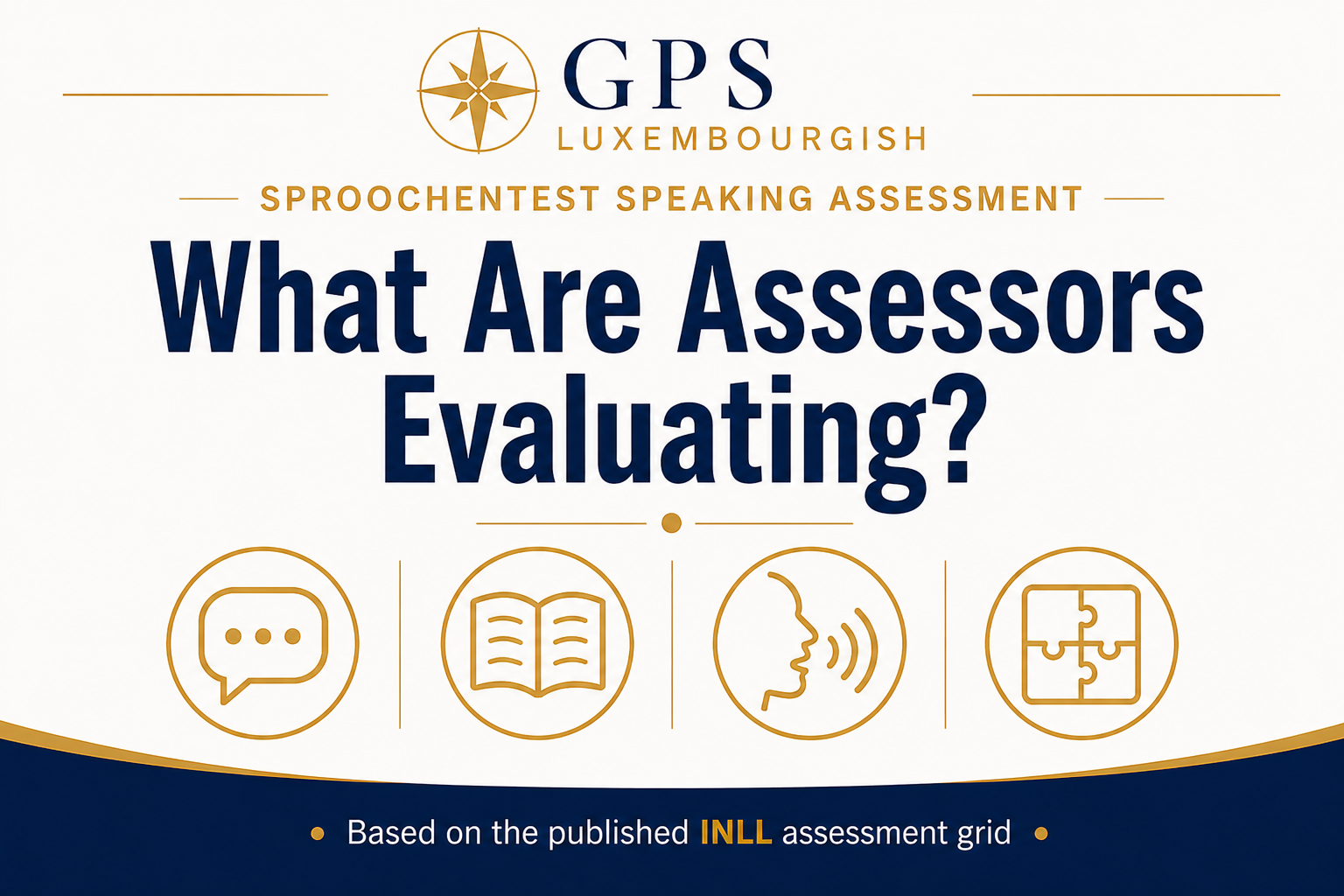
How Is the Sproochentest Speaking Test Actually Scored?
How Is the Sproochentest Speaking Test Actually Scored?
The published INLL assessment grid identifies four areas of spoken performance. Learn what assessors evaluate, how the two assessments are weighted, and how to use those criteria to make your practice more focused.
When you’re preparing for the Sproochentest, it’s easy to focus on the questions.
Did I study enough themes?
Do I know enough vocabulary?
What if I make a grammar mistake?
But there’s another useful way to look at your preparation: What are the assessors actually evaluating when you speak?
The Institut national des langues Luxembourg (INLL) publishes an assessment grid for the oral portion of the Sproochentest. That grid identifies four areas of spoken performance:
Vocabulary. Grammatical structures. Phonetics. Task fulfillment.
Looking at those four areas gives us a clearer picture of what the assessors are evaluating during the oral assessment.
1. Lexik: Vocabulary
The first criterion is Lexik, or vocabulary.
The INLL assessment grid describes this area in terms of the range and appropriate use of vocabulary at A2 level.
That tells us more than simply “vocabulary matters.”
During the oral assessment, you need to be able to use vocabulary as part of your spoken communication.
Think about what happens across different interview themes. You might need words to describe your daily routine, talk about something that happened in the past, explain a preference, describe a person or place, or give your opinion.
The topic may determine which vocabulary you need, but Lexik remains one of the four areas being assessed.
For practice, that gives you a useful question to consider:
Do I have enough usable vocabulary to express what I want to say?
2. Morphosyntax: Grammatical Structures
The second criterion is Morphosyntax.
The INLL grid describes this area in terms of the range and appropriate use of grammatical structures at A2 level.
Grammar, therefore, is clearly part of the assessment.
It can be helpful to think about grammar in the context of what you need to communicate.
If you’re describing your normal routine, you need grammatical structures that allow you to talk about your everyday life.
If you’re talking about something that happened previously, you need structures that allow you to speak about the past.
If you’re explaining a preference or opinion, you need to be able to connect and structure those ideas.
So grammar practice for the Sproochentest isn’t limited to completing written grammar exercises. During the oral assessment, you have to be able to use grammatical structures while speaking.
For practice, consider:
Can I use the grammatical structures I need to express this response?
3. Phonetik: Being Understood and Speaking Fluently
The third criterion is Phonetik.
The wording in the INLL assessment document is particularly useful here. It asks how well the candidate can be understood and how fluently they speak.
The assessment grid also describes this area in terms of expressing yourself clearly and fluently.
That gives us a broader picture than simply thinking about whether every individual word is pronounced perfectly.
When you practice, listen to your answer as spoken communication.
Can another person understand what you’re saying?
Are you able to produce your response aloud?
Where do you consistently hesitate?
Are there words or structures you know on paper but struggle to produce when speaking?
This is one reason speaking aloud can reveal things that studying vocabulary, grammar, or written answers alone may not.
For practice, consider:
Can I be understood, and how fluently am I able to express my response?
4. Aufgabenerfüllung: Fulfilling the Communication Task
The fourth criterion is Aufgabenerfüllung, or task fulfillment.
The INLL document asks whether the candidate can establish communication at A2 level and structure it clearly.
The assessment grid also refers to participating in a conversation and making a description, as well as expressing yourself understandably and coherently in Luxembourgish.
This criterion looks at the communication task more broadly.
Can you participate in the exchange at A2 level?
Can you express your response in Luxembourgish in a way that is understandable and coherent?
Can you structure what you want to communicate clearly?
This is useful because it looks beyond individual vocabulary, grammar, or pronunciation features and considers your ability to use the language to communicate.
For practice, consider:
Am I able to communicate my response clearly and coherently?
Looking at the Four Criteria Together
Looking at the assessment grid as a whole gives us a useful way to think about spoken Luxembourgish.
You need vocabulary to express your ideas.
You need grammatical structures to put those ideas into language.
Your speech needs to be understandable and sufficiently fluent.
And you need to be able to use the language to communicate at A2 level in a clear and structured way.
That gives you a more specific way to listen to your own practice.
Instead of simply asking:
“Did I make mistakes?”
try asking:
Did I have the vocabulary I needed?
Could I use the grammatical structures I needed?
Could someone understand me when I spoke?
Could I communicate my response clearly and coherently?
Those questions reflect the four areas identified in the published assessment grid.
How the Scoring Works
The INLL assessment grid shows a 0–5 scale for each of the four criteria.
The document also explains that two assessors evaluate the candidate separately, directly after the oral test.
Both assessments contribute to the final oral result, but they are not weighted equally.
The Gespréichspartner, or conversation partner, accounts for 20% of the final result.
The Bewäerter, or evaluator, accounts for 80% of the final result.
So while both assessors evaluate the candidate’s performance, the evaluator’s assessment carries the greater weighting in the final result.
What Does a 3, 4, or 5 Mean?
The grid shows scores from 0 through 5, but it does not include individual performance descriptions explaining exactly what distinguishes each number.
So while we know what is being assessed, the published grid does not give us enough information to create our own definitions for what earns a 3, 4, or 5.
That means the criteria can help you understand your speaking strengths and identify areas that need more practice, but they should not be turned into an unofficial scoring formula.
Use the Grid to Make Your Practice More Specific
The next time you record yourself answering a Sproochentest practice question, don’t listen only for mistakes.
Instead, use the four published assessment areas as four different lenses.
Lexik: Did I have the vocabulary I needed to express myself?
Morphosyntax: Could I use the grammatical structures I needed?
Phonetik: Could I be understood, and how fluently was I able to speak?
Aufgabenerfüllung: Could I communicate my response clearly and coherently at A2 level?
You aren’t assigning yourself an official Sproochentest score.
You’re doing something you can actually use: identifying where your speaking needs more practice.
Maybe vocabulary is making it difficult to express your ideas.
Maybe you know what you want to say but struggle to access the grammatical structures while speaking.
Maybe your answer is strong on paper but becomes difficult to produce aloud.
Or maybe the individual language pieces are there, but you need more practice putting them together into clear spoken communication.
Those are much more specific problems to work on than simply deciding:
“My Luxembourgish isn’t good enough.”
The Bottom Line
The Sproochentest oral assessment isn’t evaluated through one single lens.
According to the published INLL assessment grid, assessors are looking at four areas:
Lexik — vocabulary
Morphosyntax — grammatical structures
Phonetik — understandability and fluency
Aufgabenerfüllung — communicating at A2 level and structuring that communication clearly
The grid also shows that each criterion is scored on a 0–5 scale and that two assessors contribute to the final result, weighted at 20% and 80%.
Knowing these criteria won’t tell you exactly what score an INLL assessor would give you.
But it can tell you something extremely useful:
what to listen for when you practice.
Instead of leaving a practice session wondering whether your Luxembourgish was simply “good enough,” you can identify the part of your speaking that needs attention and make your next practice session more focused.
Source Note: This article is based on the published Sproochentest oral assessment materials from the Institut national des langues Luxembourg (INLL). GPS Luxembourgish is an independent educational resource and is not affiliated with or endorsed by INLL. Candidates should consult INLL for current official Sproochentest information.
Put What You Know Into Practice
Understanding what is assessed is one part of preparing. The next step is practicing the skills you’ll need to use during the interview.
Need help understanding and navigating the interview?
The GPS Method Guide helps you understand the interview structure, recognize where questions are going, and build responses without relying on memorized scripts.
Need to work on your own answers and speaking skills?
The GPS Method Workbook gives you structured practice for building responses, working through follow-up questions, and evaluating your preparation.
Ready to practice complete interviews?
The GPS Interview Collections give you theme-based interview practice so you can work on responding across a developing conversation.
Sproochentest Questions: How to Practice for the Oral Interview
If you’re preparing for the Luxembourgish Sproochentest, practicing questions is important.
But how you practice those questions matters too.
It’s easy to become comfortable with a list of familiar questions. You read the question, recognize it immediately, and give the answer you’ve practiced.
That can be useful for building vocabulary and confidence.
But the oral assessment asks you to do something different: listen to a question, understand what it is asking, and respond directly and relevantly using the Luxembourgish you have.
Your practice should help you prepare for that.
Don’t Just Learn Answers. Learn to Navigate Questions.
A preparation question can help you practice vocabulary, sentence structure, and ideas you might want to talk about.
The problem comes when you begin relying on the exact wording of the question—or on one prepared answer.
If the wording changes, a follow-up takes the topic in another direction, or you hear a word you don’t recognize, that carefully prepared answer may no longer help.
Instead, practice identifying the direction of the question.
Ask yourself:
What is the question asking me to talk about?
Is it asking about the present, past, or future?
Is it asking for a reason, an opinion, a description, or an experience?
What words do I recognize?
What relevant information can I give in response?
You don’t necessarily need to understand every word before you can understand enough to respond.
Build a Menu, Not a Script
Instead of preparing one perfect answer for each question, prepare several things you could say about a theme.
For example, if you’re practicing Wunnen (where you live), your “menu” might include:
where you live
how long you have lived there
what your home is like
what you like about your neighborhood
places you visit nearby
where you lived before
something you would change
Now you have options.
If you forget a word or the question goes in a slightly different direction, you aren’t dependent on remembering one particular sentence.
You can choose another relevant route.
That flexibility is much more useful than trying to reproduce a memorized answer exactly.
Practice Questions You Haven’t Previewed
One simple way to change your practice is to put the questions in someone else’s hands.
Give a set of questions to a partner, friend, tutor, or family member.
Then don’t look at them.
Have the other person ask one question at a time in Luxembourgish.
Your job is to:
Listen → find the direction → answer directly → add a relevant detail when helpful → stop.
Then wait for the next question.
The other person does not need to imitate an examiner. The value of the exercise is simply that you no longer control which question comes next.
That changes the practice condition.
Practice Follow-Up Questions Too
Don’t stop after practicing the obvious opening questions for a theme.
Follow-up questions can require you to explain, compare, describe an experience, give a reason, or move between different time frames.
For example, answering a question about what you usually do on vacation is different from answering one about what happened on your last vacation.
Both may involve the same general theme, but they require different language.
So when you practice a theme, vary the questions.
Practice:
present routines
past experiences
preferences
reasons
descriptions
opinions
comparisons
simple future plans
The goal isn’t to predict every possible question.
It’s to become more comfortable responding when the question changes.
Listen for What You Do Understand
An unfamiliar word does not automatically mean you cannot answer the question.
Instead of focusing entirely on the word you missed, listen for the information you did understand.
Can you identify:
the question word?
the theme?
a time cue?
a familiar verb?
two or three useful words?
Those pieces may give you enough information to understand the direction of the question.
Then respond using the Luxembourgish you have.
This is also something you can practice deliberately. Have someone read questions aloud without showing you the written version. Notice which words help you determine what the question is asking.
Record Yourself
Speaking silently in your head is not the same as answering aloud.
Record yourself responding to practice questions.
Then listen back.
Ask:
Did I understand the question?
Did I answer it directly?
Was my answer relevant?
Did I demonstrate usable vocabulary?
Could I add an appropriate relevant detail?
What happened when I didn't immediately know a word?
You may notice things in a recording that aren't obvious while you're speaking.
Then try again.
That repetition—listen, respond, review, adjust, repeat—can make practice much more useful.
A Free Tool to Help You Decode Questions
If figuring out what a question is asking is difficult, the free GPS Question Decoder can help you practice recognizing different types of questions and finding their direction.
It isn't an answer sheet.
It's a tool for helping you understand what kind of response a question is asking you to produce.
Get the free Question Decoder:
GPS Luxembourgish Resources
When You’re Ready to Go Beyond Individual Questions
Eventually, practicing individual questions isn't enough.
You also need opportunities to practice answering questions without knowing what is coming next.
That is why I created the GPS Interview Collections.
Each collection provides structured oral-interview practice organized around Sproochentest themes. Give the interview to someone else, let them control the questions, and focus on listening and responding rather than previewing what comes next.
You’ve practiced the questions. Now practice not knowing what’s coming next.
Explore GPS Interview Collections →
Keep Learning
Looking for more Sproochentest preparation strategies and free tools? Explore the GPS Learning Resources.
Sproochentest Questions: How to Answer a Question You Didn’t Prepare For
You don’t need to prepare an answer for every possible question. You need to learn how to find a direction when the question is unfamiliar.
When I was preparing for the Luxembourgish Sproochentest oral interview, I spent a lot of time practicing questions.
That helped.
But it also created a problem.
The more questions I practiced, the more I started to feel like I needed to have an answer ready for every question I might be asked.
Of course, that isn’t possible.
You can prepare common topics. You can practice lots of questions. You can become comfortable talking about your life, your routines, your preferences, and your experiences.
But eventually, someone can ask you a question you haven’t practiced before.
That doesn’t mean you can’t answer it.
It just means you need a way to find your direction.
The Question Doesn’t Have to Be Familiar
There’s an important difference between:
“I’ve never practiced this exact question.”
and:
“I can’t answer this question.”
Those are not the same thing.
When an unfamiliar question comes up, the first instinct can be to search your memory:
Have I practiced this one?
Do I have an answer for this?
What was I supposed to say?
But instead of searching for a prepared answer, try listening for what the question is actually asking you to do.
That gives you somewhere to start.
First: What Is the Question Asking?
Before you think about your whole answer, identify the job of the question.
Is it asking you to:
Describe something?
Talk about what you usually do?
Give a preference?
Explain why?
Talk about something that happened in the past?
Give an opinion?
Give an example?
You may not have practiced the exact question.
But you have probably practiced doing many of those things in Luxembourgish.
That distinction matters.
Instead of thinking:
“I don’t know this question.”
you can start thinking:
“I know what this question wants me to talk about.”
Now you have a direction.
Start With the Part You Can Answer
Once you understand what the question is asking, don’t try to build your entire answer before you start speaking.
Answer the most direct part first.
For example, imagine you are asked a question about something you normally do on the weekend.
You don’t need to immediately create a long description of your entire weekend.
Start with the answer.
Samschdes ginn ech dacks akafen.
On Saturdays, I often go shopping.
You’ve answered the question.
Now you can decide whether a detail would help.
Ech ginn normalerweis moies, well et méi roueg ass.
I usually go in the morning because it’s quieter.
That’s enough to create a relevant answer without having prepared those exact sentences in advance.
Use What You Already Know
One of the most useful things you can build during your preparation isn’t a collection of perfect answers.
It’s a collection of things you can comfortably talk about.
Your routines.
Your family.
Your work.
Your hobbies.
Places you go.
Things you like and dislike.
Experiences you’ve had.
Reasons for your preferences.
Simple examples from your life.
These pieces can be useful in many different answers.
The question may change.
The Luxembourgish you use to answer it often doesn’t have to.
Don’t Force a Prepared Answer Onto a Different Question
There’s another trap that can happen when you practice a lot of prepared questions.
You hear a familiar word or topic and immediately start giving the answer you practiced.
But the actual question may be asking something slightly different.
For example, you might have practiced talking about what you like to do on vacation.
Then you hear a question about vacation and begin giving that answer.
But perhaps the question was actually asking about your last vacation.
Same general topic.
Different question.
That’s why listening to the whole question matters.
Before reaching for a prepared answer, ask:
What am I actually being asked?
Then answer that.
Give Yourself One Direction at a Time
You don’t need to know where your entire answer is going before you begin.
Think about the next useful piece.
Answer the question.
Then:
Add one relevant detail.
If another detail genuinely helps:
Add it.
Then stop.
This is the same structure I use in the GPS Answer Formula:
Answer directly → add one detail → add another detail if it helps → then stop.
An unfamiliar question doesn’t change that structure.
It just means you have to choose your direction before you start.
What If You Need a Moment?
An unfamiliar question may take a little more processing than one you have practiced many times.
That’s okay.
Your first job is still to understand what was asked.
Listen for the important information in the question.
What is the topic?
What kind of information are you being asked to provide?
Is the question about now, something you usually do, or something that happened before?
Once you identify that, you can start with a simple answer.
You don’t need to create the perfect response in your head first.
Practice Unprepared Questions on Purpose
This is one of the most useful changes you can make to your speaking practice.
Don’t practice only questions you already know.
Occasionally have someone give you a question you haven’t prepared.
Or create a group of questions, mix them up, and answer them without deciding in advance which ones you’ll practice.
The goal isn’t to catch yourself out.
The goal is to practice the moment when you have to:
Listen → understand → choose a direction → respond.
That is a different skill from repeating an answer you have already practiced.
And it gets easier with practice.
Try This During Your Next Practice Session
The next time you hear a question you haven’t prepared, don’t immediately think:
“I don’t have an answer for this.”
Instead, ask yourself:
What is the question asking me to do?
Then:
What is the simplest direct answer I can give?
What relevant detail can I add?
Would another detail actually help?
Then stop.
You don’t need to know every question in advance.
You need to be able to find a direction when you hear one.
Continue Learning
If unfamiliar questions are difficult because you sometimes understand the idea but can’t find the Luxembourgish word you want, read:
What to Do When You Don’t Know a Word in Luxembourgish
And if your challenge is knowing how much to say, start with:
Why I Stopped Trying to Give the “Perfect” Answer
You can also use the free GPS Answer Formula and GPS Keep Moving Tool during your speaking practice.
Together, these strategies address three different moments:
How do I answer?
→ GPS Answer Formula
What do I do when I get stuck?
→ GPS Keep Moving Tool
What do I do when I didn’t prepare this question?
→ Listen, identify the direction, and answer what was actually asked.
You’ve practiced the questions. Now practice not knowing what’s coming next.
Explore GPS Interview Collections →
Keep Learning
Looking for more Sproochentest preparation strategies and free tools? Explore the GPS Learning Resources.
About GPS Luxembourgish
GPS Luxembourgish provides independent educational resources designed to help learners prepare for the Luxembourgish Sproochentest oral interview.
The focus is practical communication and structured preparation—not memorizing scripts or trying to predict exactly what you’ll be asked.
Learn to navigate the interview—not memorize it.
What to Do When You Don’t Know a Word in Luxembourgish
One missing word doesn’t have to stop your entire answer.
When I was preparing for the Luxembourgish Sproochentest oral interview, there was one thing that could stop me almost immediately:
I wouldn’t know the word I wanted.
I could know exactly how I wanted to answer the question. I could have the entire idea in my head.
But if I couldn’t remember one particular word in Luxembourgish, everything would stop.
I’d search for it.
I’d try to translate it.
I’d start second-guessing myself.
And sometimes I’d lose the rest of the answer along with it.
Eventually, I realized the problem wasn’t always my vocabulary.
The problem was that I thought there was only one way to say what I wanted to say.
I Was Trying to Translate My English Answer
A lot of my early practice started in English.
I would think about exactly what I wanted to say, build the answer in my head, and then try to translate that answer into Luxembourgish.
Sometimes it worked.
But it created a problem.
The English version might require vocabulary or sentence structures that I didn’t have in Luxembourgish.
So the moment I reached something I couldn’t translate, I felt stuck.
What I eventually started asking myself was much simpler:
What CAN I say?
Not:
How do I translate exactly what I wanted to say in English?
That small change gave me options.
Find Another Route
If I didn’t know a word, I started looking for another way to communicate the same basic idea.
There were a few ways I could do that.
Say It Another Way
Sometimes I knew enough Luxembourgish to explain the idea differently.
I didn’t need the exact word I originally wanted.
I just needed words that communicated what I meant.
Make It Simpler
Sometimes the sentence I was trying to create was simply more complicated than it needed to be.
Instead of struggling through one complicated sentence, I could use two easier ones.
A simpler answer can still communicate your idea clearly.
Change the Example
This one helped me a lot.
Imagine you’re giving an example and suddenly realize that you don’t know the vocabulary you need to finish it.
You don’t have to keep fighting with that example.
Choose another one.
You’re answering the question—not defending the example you originally chose.
Keep Moving
This was probably the biggest change for me.
I stopped treating a missing word as an emergency.
If I could find another way to communicate the idea, I kept going.
And if I had already communicated enough?
I stopped.
Then I listened for the next question.
Same Direction. Simpler Route.
Imagine I wanted to express the idea that I enjoy hiking because I like being surrounded by nature.
But I couldn’t remember how to express “surrounded.”
Earlier in my preparation, I might have gotten stuck trying to find that exact word.
Instead of trying to reproduce the exact English sentence, I could simplify the idea:
Ech gi gär trëppelen. Ech si gär an der Natur.
It isn’t an exact translation—and that’s the point.
I’ve changed the route, but I can still communicate something close to what I wanted to say.
Same direction. Simpler route.
You’re Communicating, Not Translating
This became an important distinction in the way I practiced.
I wasn’t trying to prove that I could translate everything I could say in English into Luxembourgish.
I was trying to communicate in Luxembourgish.
Those are very different goals.
Once I stopped requiring my Luxembourgish answers to perfectly reproduce the thoughts I had in English, speaking became much more manageable.
I could work with the language I actually had.
Try This During Your Next Practice Session
The next time you get stuck on a word, resist the urge to immediately stop and search for the translation.
Instead, ask yourself:
Can I say it another way?
Can I make the sentence simpler?
Can I use a different example?
Have I already said enough?
Then keep moving.
Because you don’t always need the missing word.
Sometimes you just need another route.
Download the Free GPS Keep Moving Tool
I created a free one-page GPS Keep Moving Tool to keep beside you while you practice.
It gives you four strategies when you get stuck:
Say it another way.
Make it simpler.
Change the example.
Keep moving.
Use it during speaking practice until finding another route starts to become more natural.
↓ Download the Free GPS Keep Moving Tool
Continue Learning
If your bigger challenge is knowing how much to say when you answer a question, start with the GPS Answer Formula.
It gives you a simple structure:
Answer the question → Add one detail → Add another detail if it helps → Then stop.
Together, the two tools address two different speaking problems:
GPS Answer Formula: How do I build my answer?
GPS Keep Moving Tool: What do I do when I get stuck?
Want to understand how the GPS Method fits together?
The GPS Method Guide explains the approach, including how to build an answer and keep moving when you get stuck.
Explore The GPS Method Guide →
Want to put the method into practice?
The GPS Workbook gives you structured opportunities to practice applying the method to Sproochentest questions.
Keep Learning
Looking for more Sproochentest preparation strategies and free tools? Explore the GPS Learning Resources.
About GPS Luxembourgish
GPS Luxembourgish provides independent educational resources designed to help learners prepare for the Luxembourgish Sproochentest oral interview.
The focus is practical communication and structured preparation—not memorizing scripts or trying to predict exactly what you’ll be asked.
Learn to navigate the interview—not memorize it.
Why I Stopped Trying to Give the Perfect Answer
The biggest change in my Sproochentest preparation wasn't my vocabulary—it was how I thought about answering.
When I first started preparing for the Luxembourgish Sproochentest oral interview, my answers were actually too short.
I'd answer the question with a single sentence and stop.
I knew I needed to say more, but I wasn't sure how much more.
So I overcorrected.
I started trying to give long, complete answers about every topic. If someone asked me about my hobbies, I wanted to mention every hobby I had. If they asked about my family, I tried to describe everyone. I believed that a longer answer would show that I knew more Luxembourgish.
Instead of feeling more confident, I felt more overwhelmed.
Then I made a second mistake.
I tried to think of exactly what I wanted to say in English and then translate it into Luxembourgish.
Sometimes that worked.
But the moment I reached a word I didn't know, everything stopped.
I'd freeze because I couldn't remember the exact translation I wanted.
Looking back, I realized I wasn't struggling with Luxembourgish as much as I was struggling with my own expectations.
I thought I needed to give the perfect answer.
I didn't.
The Change That Helped Me Most
Eventually, I stopped trying to build the perfect answer.
Instead, I started following a simple structure.
Answer the question.
Add one supporting detail.
Add another detail if it helps.
Then stop.
That simple change completely changed the way I practiced.
Instead of trying to remember a paragraph, I only needed to think about my next idea.
If I didn't know one specific word, I learned to explain it another way instead of freezing.
I wasn't trying to sound perfect anymore.
I was trying to communicate.
Ironically, that made speaking feel much more natural.
Why I Created the GPS Method
That experience became the foundation of the GPS Method.
The GPS Method isn't about memorizing long answers.
It isn't about predicting exactly what you'll be asked.
It's about learning a framework that helps you organize your thoughts and communicate naturally, even when you don't know exactly what question is coming next.
For me, that was a much more realistic way to prepare.
Try It During Your Next Practice Session
The next time you practice, don't ask yourself:
"What is the perfect answer?"
Instead, ask yourself:
Did I answer the question?
Did I add one supporting detail?
Would another detail actually help?
If not…
Then stop.
Sometimes the strongest answer isn't the longest one.
It's simply the one that answers the question clearly.
Download the Free GPS Answer Formula
If you'd like a printable reminder, I've created a free one-page GPS Answer Formula that summarizes this framework.
Keep it beside you while you practice speaking.
It's a simple reminder that has made a big difference in my own preparation.
⬇ Download the Free GPS Answer Formula
Want to understand how the GPS Method fits together?
The GPS Method Guide explains the approach, including how to build an answer and keep moving when you get stuck.
Explore The GPS Method Guide →
Want to put the method into practice?
The GPS Workbook gives you structured opportunities to practice applying the method to Sproochentest questions.
Keep Learning
Looking for more Sproochentest preparation strategies and free tools? Explore the GPS Learning Resources.
About GPS Luxembourgish
GPS Luxembourgish provides independent educational resources designed to help learners prepare for the Luxembourgish Sproochentest oral interview. Our focus is on building practical communication skills and confidence through structured preparation—not memorizing scripts.